

You have no items in your shopping cart.


Tails
Making pet parenting easy
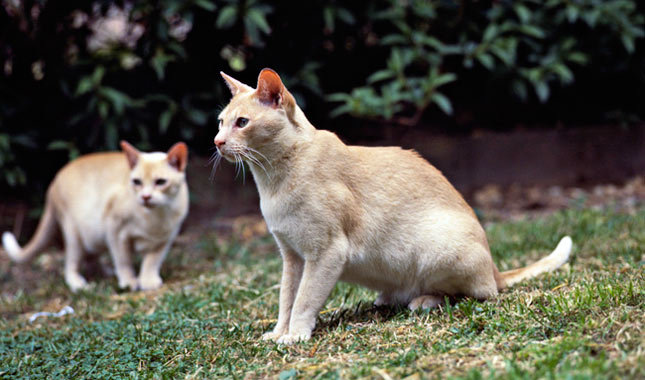
Burmese
This entry was posted on 2014-08-13.
The Burmese breed thrives on human interaction. It is somewhat like a dog, in its tendency to follow its owner around wanting and giving affection. There have even been many cases where the Burmese has been thought to play fetch.
Traits
• Weight: Male: 4-5 kg; Female: 3-4kg
• Height: small-medium size
• Coat: thick, satiny, fine and close lying
• Colour: Sable, Lilac, Chocolate, Red, Lilac tortie, Blue, Chocolate tortie, Brown tortie, Blue tortie, Cream, Red tortie, and Cream tortie.
• Litter size: About 6 kittens
• Life span: 14-16 years.
Physical Characteristics
Over the years the appearance of the Burmese has experienced a substantial amount of change. In 1953 it was described as medium sized, delicate, and lengthily and in 1957 it was described as halfway between Siamese and Domestic Short-hair. The two main types of this breed are contemporary Burmese and European Burmese. The contemporary Burmese’s muzzles are wider and shorter, the nose has a noticeable break and the heads shapes are rounder and wider. The European Burmese has muzzles that are slimmer and lengthy consisting of a less noticeable nose break and a somewhat narrower head. In addition the contemporary Burmese’s coat is brown while the European Burmese comes in far brighter colours e.g. red.
Personality and Temperament
The Burmese is fairly versatile being equally content in a home, office or shop. It is playful, smart, and lively and thoroughly enjoys entertaining its family with its amusing antics.
The females and males dispositions have certain differences: females are far more curious and are more emotionally bound to their families. Males are also very fond of their family’s company but are far quieter. They equally show an intense interest in food.
The Burmese’s voice is husky almost like its throat is sore from talking too much. It’s not as loud as its equivalent the Siamese, but will purr if irritated or uneasy.
History and Background
The Burmese breed originated in Burma and in this country is occasionally named the copper cat. Dating back thousands of years the legend states that its forefathers were worshiped as Gods in the temples of Burma. Wong Mau a female cat found in Burma (presently known as Myanmar) is the decedent of the Burmese breed. In the beginning of the 1930s Dr. Joseph Thompson a United States Navy medical officer exported the cat to the U.S.
A person of numerous interests Dr. Joseph Thompson had served in Tibet as a Buddhist monk, immediately taking an interest in the brown, short-haired felines that resided there. After he had obtained Wong Mau he chose to start a breeding program. As Wong Mau had no male equivalent, Dr. Joseph Thompson crossed her with a Siamese seal-point whose name was Tai Mau. The coat colours of the kittens delivered were brown, beige and point. He crossed the brown kittens with either their mother or each other, resulting in more Burmese felines.
In 1936 the Cat Fancier's Association (CFA) officially acknowledged the Burmese breed. During this time breeders started bringing more cats from Burma to the U.S, resulting in some dilution of the breed. People began to sell hybrid Burmese stating that they were purebreds causing protests and the CFA to withdraw it recognition of the breed. Despite the disheartening situation breeders who wished the breed success continued to work. In 1953 the Burmese was once again granted recognition and in 1959 it gained champion status rewarding the breeders efforts. In order to better distinguish this breed only cats with solid coat colours not marred by markings were allowed. At present the Burmese breed has championship status in every arena.
Nutrition
Click here to see what cat food we sell now.

